


Yes. Most luxury crewed yacht charters provide onboard Wi-Fi, either as a standard amenity or a paid upgrade tied to how much bandwidth you actually need. Higher-spec yachts increasingly run Starlink Maritime alongside a backup system, which has changed what “connected” means at sea compared to even five years ago.
Here’s what that looks like in practice:
- Basic email, messaging, and browsing access is commonly included in the charter fee.
- Heavier use, guaranteed bandwidth, or unlimited data often carries an extra charge, especially on longer itineraries.
- In sheltered anchorages, marinas, or coastal waters, expect video calls and streaming that feel close to home.
- On extended open-sea passages, speeds can dip and latency can rise unless the yacht carries VSAT as a backup link.
The gap between “Wi-Fi is on board” and “Wi-Fi that survives a board meeting in the middle of the Tyrrhenian Sea” comes down to which technology stack the vessel runs, and that’s worth understanding before you sign a charter agreement.
Key Takeaways
Reliable onboard Wi-Fi during a luxury yacht charter depends on a hybrid technology stack, clear billing terms, and confirming bandwidth for your specific itinerary before you book.
| Point | Details |
|---|---|
| Basic Wi-Fi is standard | Most charters include basic access; premium bandwidth or large data allowances often cost extra. |
| Hybrid stacks perform best | Starlink Maritime paired with VSAT backup and 4G/5G near shore delivers the most consistent connection. |
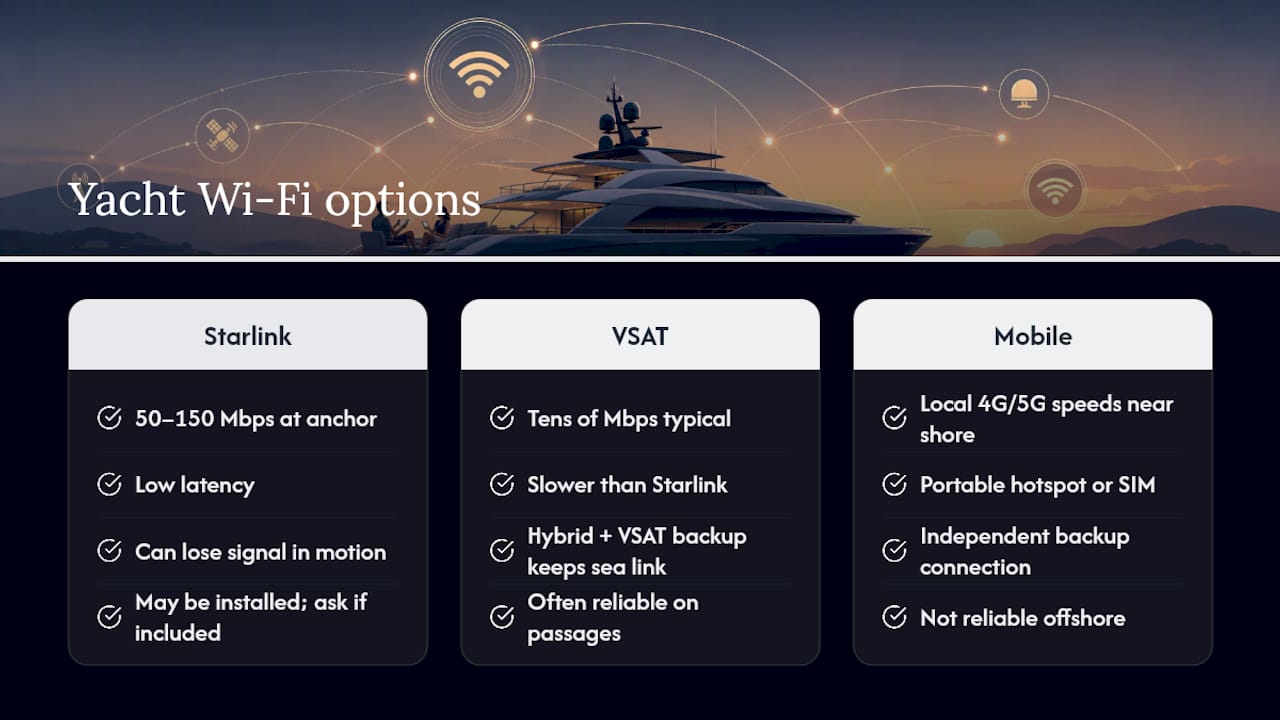
| Speeds vary by conditions | Starlink often runs 50 to 150 Mbps at anchor but drops during motion, congestion, or poor sky view. |
| Ask before you book | Request documented speed tests and written connectivity terms in the charter contract. |
| Etcharters confirms readiness | Vessels can be equipped with Starlink or hybrid setups, with itinerary-specific bandwidth confirmed pre-charter and 24/7 support throughout. |
Table of Contents
- What to Expect From Wi-Fi in Barca: Billing and Service Models
- How Onboard Wi-Fi Actually Works at Sea
- Real-World Speeds and What Actually Slows You Down
- The Questions to Ask Before You Book
- Book a Charter With Connectivity Confirmed in Advance
- Frequently Asked Questions
- Sources
What to Expect From Wi-Fi in Barca: Billing and Service Models
Charter operators handle connectivity in one of three ways, and knowing which model you’re booking under changes what you should ask for.
- Complimentary basic access. Many yachts include standard Wi-Fi for email, messaging, and light browsing at no extra cost, similar to how a hotel includes lobby Wi-Fi but reserves faster tiers for a fee.
- Paid upgrade tiers. Some operators charge per device, per gigabyte, or per satellite terminal session for higher-speed access, particularly useful if you’re streaming, video conferencing, or working remotely during the charter.
- Contracted VSAT or hybrid packages. Larger yachts on annual charter programs often carry dedicated VSAT contracts bundled into the seasonal operating cost, which shows up as a flat inclusion rather than a per-trip fee.
Yacht size and itinerary shape all of this. A 60-foot motoryacht doing day charters along the coast rarely needs more than 4G backhaul and a solid onboard router. A 90-plus-foot vessel running a two-week Mediterranean passage, moving between Sardinia, the Balearics, and the French Riviera, needs a stack that doesn’t drop out the moment it loses cell tower range.
“Included” rarely means unlimited. Most operators cap device counts, throttle bandwidth after a data threshold, or apply fair-use policies that quietly slow speeds during peak hours. That detail almost never makes it into marketing copy, but it should be in your booking paperwork. If it isn’t, ask for it in writing before the charter starts. A charter contract that specifies connectivity terms the same way it specifies fuel policy or crew gratuities saves you a frustrating conversation on day three.
How Onboard Wi-Fi Actually Works at Sea
You don’t need to understand satellite engineering to book smart, but knowing the basic layers helps you ask better questions.
- Starlink Maritime is the low-earth-orbit (LEO) service now standard on many higher-spec charter yachts. It delivers lower latency and higher throughput than older satellite systems, which is why it’s become the default choice for guest internet.
- VSAT is the older geostationary satellite technology. It’s slower and pricier than Starlink, but it remains the dependable backup when Starlink loses its sky view or a boat moves outside coverage, and serious hybrid installations still keep it in the mix.
- 4G/5G cellular takes over near shore, often outperforming satellite links when the yacht is within range of a strong tower, which matters along a well-covered coastline.
- Marina Wi-Fi exists but should be treated as a bonus, not a plan, given how much its quality varies from one port to the next.
Pro Tip: Ask whether the yacht’s system automatically switches between Starlink, VSAT, and cellular, or whether the crew has to manually reconnect. Automatic failover through an SD-WAN router, similar to Peplink SpeedFusion, is the difference between a five-second blip and a fifteen-minute outage during your call.
Onboard, the signal reaches your cabin through a Wi-Fi 6 or Wi-Fi 6E mesh network with enterprise-grade access points spread across decks and staterooms. Well-designed networks also run VLAN segmentation, which keeps guest devices on a separate virtual network from the yacht’s navigation and safety systems. That’s not a luxury detail. It’s a security basic that any charter with serious technology should already have in place.
Real-World Speeds and What Actually Slows You Down
Expect a range, not a fixed number. Starlink Maritime commonly delivers 50 to 150 Mbps at anchor with sub-100 millisecond latency, which comfortably handles HD video calls and typical streaming. VSAT, by contrast, usually runs in the tens of Mbps, adequate for browsing and messaging but noticeably tighter once several guests compete for bandwidth.
Several things push those numbers around during an actual charter:
- Vessel motion. A boat swinging at anchor or cutting through swell can briefly interrupt the satellite dish’s line of sight to the sky.
- Antenna obstruction. A flybridge awning, a raised tender, or a poorly positioned dome can block the signal path.
- Regional congestion. Popular anchorages during peak season put more devices on the same cell towers or satellite beams.
- Weather. Heavy rain or storm systems degrade both Starlink and VSAT performance, though Starlink typically recovers faster.
- Device density. Five cabins streaming 4K simultaneously is a very different load than one guest on a single HD video call.
That last point deserves a concrete example. A single video call for a board meeting rarely stresses a hybrid system running Starlink. Ten devices streaming Netflix in four cabins while someone’s on a Zoom call in the salon is a different story, and it’s exactly the scenario where a properly bonded, multi-link setup earns its cost over a single-source connection. Connectivity quality is directly tied to guest satisfaction, and the industry increasingly measures that through frameworks like Mean Opinion Score, a standard for rating perceived call and streaming quality rather than raw bandwidth alone.
The Questions to Ask Before You Book
A charter broker or operator’s answers to a handful of direct questions tell you almost everything about what you’ll actually get at sea.
- Is Starlink installed, and is it included in the charter fee or billed separately? A “yes, included” answer is straightforward. “Available on request” often means an installation fee, a rental terminal, or limited availability depending on the season.
- What bandwidth was measured on this exact itinerary recently? Ask for a documented speed test from a similar route and time of year, not a generic spec sheet number.
- Are there device limits or hotspot restrictions? Some systems cap simultaneous connections, which matters if you’re traveling with family or a work team.
- What backup link exists if the primary system fails? VSAT backup, a second Starlink terminal, or nothing at all are three very different answers.
- Can connectivity terms be written into the charter contract? If reliability matters for work, get the expectation in writing rather than a verbal assurance.
Pro Tip: If you have a genuinely critical call planned, such as closing a deal or a board vote, request the charter operator confirm real-time bandwidth on the anchorage you’ll be at that day, not just the yacht’s general capability.
Getting the Most Out of Shared Bandwidth Onboard
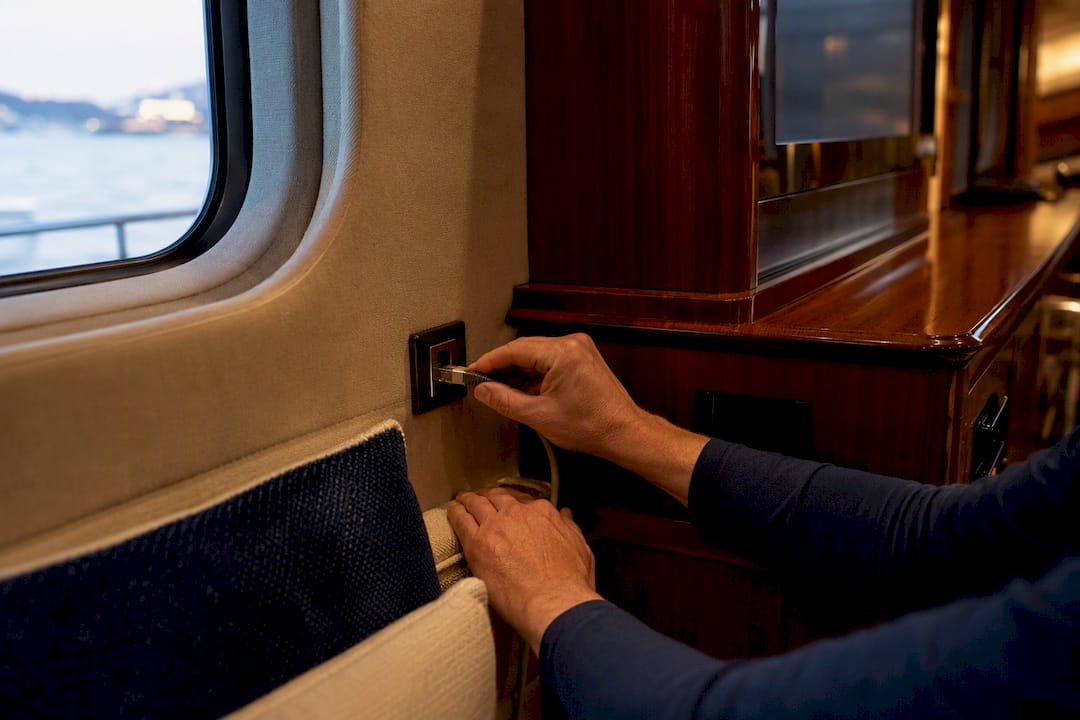
A few habits make a real difference once you’re aboard. Schedule large uploads or software updates outside peak hours, and turn off automatic phone and laptop backups that quietly eat bandwidth in the background. Use a wired connection in your cabin for anything mission-critical, if the yacht offers one. For a scheduled meeting, tell guest services or the captain in advance so they can prioritize traffic or switch to a faster link at that moment. A local 4G/5G SIM or portable hotspot is a smart personal backup, and marina Wi-Fi should stay a supplement, never your only plan.
Why Connectivity Readiness Is Part of Booking Well
Charter guests ask about connectivity almost as often as they ask about cabin layouts, and for good reason: a stalled video call or a missed family moment because a livestream buffers is a real disappointment on a trip that costs what a luxury charter costs. On Etcharters vessels, pre-charter technical checks are standard practice, covering the network setup before guests ever step aboard, backed by support available around the clock for the length of the trip. On a vessel like the San Lorenzo 62, that readiness means guests can request connectivity details specific to their planned route through Sardinia and the wider Mediterranean well before departure.
Book a Charter With Connectivity Confirmed in Advance
Etcharters treats onboard Wi-Fi as part of the charter brief, not an afterthought you discover once you’re at anchor. Vessels in the fleet can be equipped with Starlink or a hybrid setup, and the team confirms itinerary-specific bandwidth and backup options before you sign, so you’re not guessing what “Wi-Fi included” actually means on your route through Sardinia or Porto Cervo. If a business call or a family livestream matters on your trip, that’s a conversation worth having during booking, not after you’ve left the marina. Guest support runs 24/7 for the full length of your charter, covering connectivity questions the same way it covers itinerary changes or dining requests. If you’re planning a Mediterranean trip and want a vessel matched to your connectivity needs, explore available charters in Sardinia and ask directly about Starlink-equipped options for your dates. For guests planning the logistics around a charter more broadly, this step-by-step Mediterranean chartering guide from a trusted partner covers the booking process in useful detail.
Frequently Asked Questions
Is Wi-Fi always included on a luxury crewed yacht charter?
Not always as unlimited or high-speed access. Basic Wi-Fi is commonly included, but many operators charge extra for guaranteed bandwidth, additional devices, or heavy data use like streaming and video calls.
What internet speed can I expect on a yacht at anchor?
With Starlink Maritime installed, expect roughly 50 to 150 Mbps at anchor with low latency, enough for HD video calls and streaming. VSAT-only systems typically run slower, in the tens of Mbps.
Does Wi-Fi work reliably during long passages at sea?
It depends on the technology mix. A hybrid setup with VSAT backup maintains a connection during open-sea passages, while Starlink-only systems can lose signal briefly during motion or obstructed sky view.
Can I use my own mobile hotspot as backup?
Yes, and it’s a smart contingency. A local 4G/5G SIM or portable hotspot gives you an independent connection near shore, separate from the yacht’s shared network.
What should I ask the operator before booking if connectivity matters to me?
Ask whether Starlink is installed and included, what bandwidth was recently measured on your planned itinerary, whether there are device limits, and what backup system exists if the primary link fails.
Sources
- Remote Work From a Boat: The Real Guide | Boat4You
- Captains, you are your internet service provider! | SuperyachtNews

