


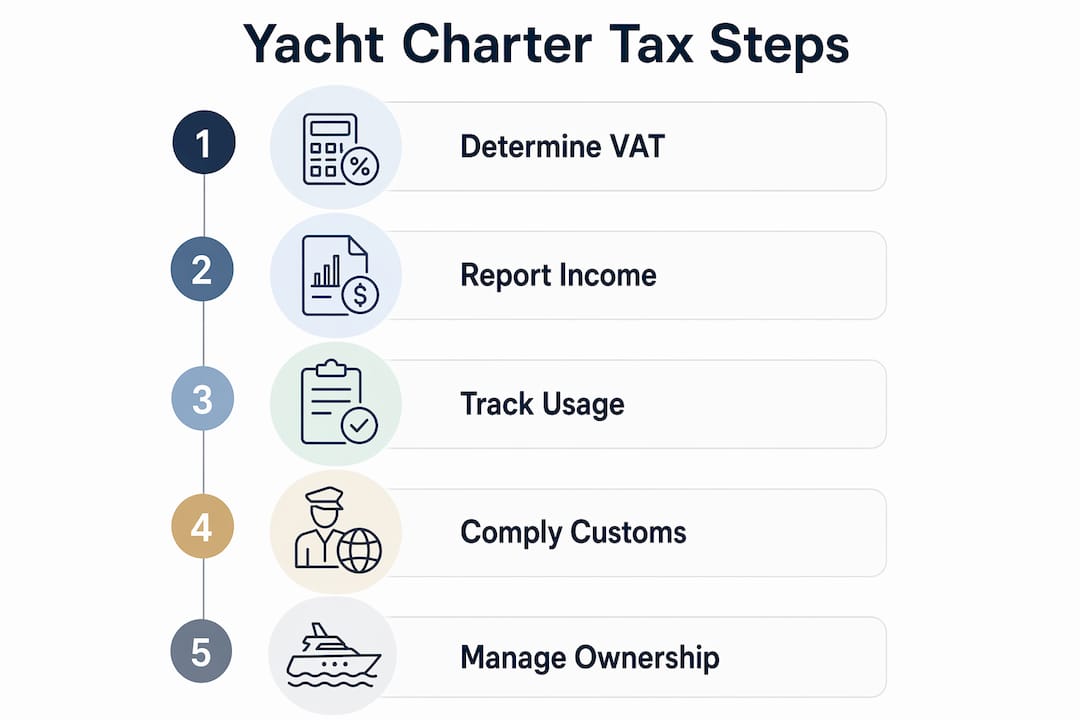
- Yacht charter tax regulations vary between the U.S. and the European Union, affecting VAT, income reporting, and customs obligations. Proper compliance relies on understanding place of supply rules, maintaining accurate documentation, and structuring ownership appropriately. Strategic planning before the season starts maximizes tax benefits and minimizes risks of penalties or claw-backs.
Yacht charter tax regulations are the legal rules governing VAT, income reporting, depreciation, and customs obligations that apply whenever a yacht is chartered commercially or privately across international waters. These rules differ sharply between the United States and the European Union, and getting them wrong costs real money. Whether you are planning to charter a yacht in the Mediterranean or exploring ownership with charter income in mind, understanding how VAT place of supply, bonus depreciation, and maritime tax obligations interact is the foundation of any sound financial decision.
How do yacht charter tax regulations work in the EU?
VAT on EU short-term yacht charters is due where the charter physically begins, regardless of where the owner or yacht sails afterward. This single rule drives every invoicing and compliance decision in European waters. A charter starting in Split triggers Croatian VAT. The same yacht departing from Genoa the following week triggers Italian VAT. The jurisdiction follows the boat’s handover location, not the owner’s residence or the flag state.
This matters operationally because charter invoices must use VAT IDs for the country where the charter commences. Mismatched VAT ID use triggers audits and penalties. Croatia enforces this strictly, and its enforcement record signals what other EU member states are moving toward. The practical implication: your charter management company must maintain separate VAT registrations in each country where you regularly embark guests.
EU VAT rates on yacht charters vary by country, ranging from 10% in Croatia to 22% in Italy, with France and Spain sitting between those figures. Each rate applies to the full charter fee collected at embarkation. Operators must track VAT at the booking level, not the fleet level, to produce a defensible audit trail.
Pro Tip: If you charter across multiple Mediterranean countries in a single season, work with an accountant who maintains active VAT registrations in Croatia, Italy, Greece, and France simultaneously. Trying to consolidate under one registration is the most common and most expensive mistake in EU charter compliance.
Temporary Admission for non-EU yachts
Non-EU flagged yachts benefit from Temporary Admission, which allows them to stay in EU customs territory up to 18 months VAT-free if conditions are met. The vessel must leave EU customs territory before the period ends, or import VAT and duty become due immediately. That liability can represent a significant percentage of the yacht’s market value.
Temporary Admission is frequently misunderstood. Many owners assume that sailing into international waters resets the clock. An Italian court ruling clarified that crossing the 12-mile limit can reset the Temporary Admission period, but this requires proper customs documentation at each crossing. Simply sailing offshore and returning without paperwork does not satisfy the requirement. Strict exit documentation and customs proof are non-negotiable to maintain VAT relief.
| Country | Standard VAT Rate on Charters | Key Compliance Requirement |
|---|---|---|
| Croatia | 13% (reduced for tourism) | Fiscalisation and digital invoice at embarkation |
| Italy | 22% | VAT registration per port of embarkation |
| France | 20% | 70% of legs must exceed 12 nautical miles for commercial VAT relief |
| Greece | 24% | VAT registration required for regular charter operations |
What are the U.S. tax rules for yacht charter income?
U.S. persons with charter yachts must report worldwide charter revenue on their federal returns, including income earned from charters conducted entirely in European waters. This worldwide income principle surprises many first-time charter owners who assume that foreign-earned charter income stays foreign. It does not. The IRS treats charter revenue as ordinary income unless the activity qualifies under specific business-use rules.
The most significant U.S. tax benefit available to charter yacht owners is bonus depreciation. U.S. tax bonus depreciation allows buyers of qualifying yachts to deduct 100% of the purchase price if the vessel is used more than 50% for business in the first year. On a $3 million yacht, that translates to over $1.1 million in tax savings at the 37% marginal rate. The Big Beautiful Bill legislation has reinforced 100% bonus depreciation for qualifying assets, making 2026 a particularly favorable year for structured charter acquisitions.
To access these deductions, you must clear the hobby loss threshold. The IRS applies hobby loss rules aggressively to yacht charter claims, and the burden of proof falls entirely on the owner. Demonstrating profit motive requires:
Documented charter bookings with signed contracts and payment records
A written business plan showing revenue projections and cost management
Evidence of active marketing through charter brokers or listing platforms
Separate business bank accounts for charter income and expenses
Logs showing that business use exceeds personal use in hours and days
Pro Tip: Keep a physical charter log aboard the vessel at all times. The IRS has disallowed deductions on yachts where the owner could not produce contemporaneous records of who was aboard, when, and for what purpose. A simple spreadsheet updated after each trip is not enough. Signed guest manifests and dated photographs add weight to your position.
Foreign asset reporting adds another layer. If your charter yacht is held through a foreign entity or generates income in a foreign account, FBAR and Form 8938 filing obligations apply once account balances exceed the relevant thresholds. Estate and gift tax exposure also applies to luxury yacht assets held abroad, which makes ownership structure planning critical before acquisition.
How does ownership structure affect your tax position?
The entity through which you own a charter yacht determines your ability to recover VAT, your exposure to claw-back adjustments, and your overall tax efficiency. Individual ownership in most EU jurisdictions blocks VAT recovery entirely. A commercial entity, whether a French SAS, a Maltese Ltd, or a German GmbH, can register for VAT and recover input tax on the purchase price and operating costs.
The distinction between a VAT-paid and a VAT-unpaid hull matters enormously in the secondary market and during operations. A VAT-paid hull has customs status confirmed within EU waters, eliminating Temporary Admission constraints. A VAT-unpaid hull relies on Temporary Admission and faces import VAT liability if the exit conditions are not met. Yacht VAT status depends more on customs documentation than on flag state, which contradicts what many owners assume when they register in a low-tax jurisdiction.
Private use of a VAT-recovered yacht creates claw-back adjustment risk unless documented and separated from business use. In France, VAT adjustment periods extend over multiple years, meaning that a yacht purchased commercially and then used privately for even a portion of the season can trigger partial VAT repayment. The ratio of commercial to private use must be tracked at the voyage level, not estimated annually.
Pro Tip: Structure your charter accounting so that every booking generates a separate invoice with the correct country VAT ID, and every owner trip generates a documented private-use entry. Mixing these in a single ledger is the fastest route to a failed VAT audit.
Charter accounting must track booking money flows and properly attribute VAT, commissions, management fees, and owner distributions at the transaction level. Proper accounting supports VAT recovery and provides the audit defense documentation that regulators increasingly demand.
How to maximize tax efficiency in yacht chartering
Tax efficiency in yacht chartering is not accidental. It results from deliberate decisions made before the charter season begins, not corrections applied after the fact. The following sequence produces the best outcomes for owners operating across U.S. and EU jurisdictions:
Choose your registration jurisdiction strategically. Malta and Delaware both offer favorable tax treatment for charter entities, but for different reasons. Malta provides EU VAT registration access and tonnage tax options. Delaware offers pass-through taxation and minimal state-level reporting. The right choice depends on where you charter, not where you live.
Log charter versus private use from day one. In France, commercial VAT recovery requires at least 70% of charter legs to cross beyond 12 nautical miles outside territorial waters, with fuel cost savings estimated at €12,000 to €36,000 annually for 15 to 25 meter motor yachts. That threshold only holds if you can prove it with dated GPS logs and signed charter agreements.
Time your Temporary Admission exits carefully. If you operate a non-EU flagged yacht in Mediterranean waters, build your season calendar around customs exit requirements. Missing the 18-month window by even a few days triggers full import VAT liability.
Align your invoicing system with place of supply rules. Every charter booking must generate an invoice from the correct VAT entity before the vessel departs. Post-dated invoicing is a red flag in every EU tax authority’s audit checklist.
Coordinate U.S. and EU tax filings with a single advisor. Owners who use a U.S. CPA for domestic returns and a separate European accountant for VAT often create gaps in their documentation. A coordinated approach prevents double reporting and catches cross-border deduction opportunities.
Pro Tip: If you are considering a Mediterranean charter in Sardinia or the Amalfi Coast, ask your charter broker which VAT jurisdiction applies to your embarkation port before signing. That single question can save you from unexpected tax exposure on your vacation costs.
What other international tax obligations apply to yacht charters?
Beyond U.S. and EU frameworks, several additional obligations affect charter operations in international waters. Estate and gift tax applies to luxury yacht assets held abroad by U.S. citizens, and the valuation of a superyacht for estate purposes often exceeds its market price due to replacement cost calculations. Proper trust or corporate structuring before acquisition reduces this exposure significantly.
Yacht crew gratuities are taxable income for crew members and must be reported accordingly. Owners who pay crew tips from the charter APA (Advance Provisioning Allowance) should understand that APA fee structures carry their own VAT and payroll implications depending on crew employment contracts and flag state labor law.
Flag state choice influences payroll tax obligations for crew. A yacht flagged in the Cayman Islands operates under different crew employment rules than one flagged in Malta or the Marshall Islands. Customs duties triggered by moving a yacht across EU borders without proper documentation can also create unexpected liabilities mid-season. The solution is a compliance calendar that maps every planned port of call against VAT, customs, and crew payroll deadlines before the season begins.
Key takeaways
Yacht charter tax compliance requires matching your ownership structure, usage documentation, and invoicing systems to the specific rules of each jurisdiction where you operate.
| Point | Details |
|---|---|
| VAT follows embarkation location | The country where guests board the yacht determines which VAT rate and registration apply. |
| Temporary Admission requires documentation | Non-EU yachts get 18 months VAT-free in EU waters, but only with proper customs exit proof. |
| U.S. bonus depreciation is substantial | A $3 million charter yacht can generate over $1.1 million in tax savings if business use exceeds 50%. |
| Private use triggers VAT claw-back | Mixing personal and charter use without documentation risks partial repayment of recovered VAT. |
| Ownership entity determines VAT access | Commercial entities recover VAT on purchase and operating costs; individual ownership generally cannot. |
What I have learned from watching owners get this wrong
I have seen clients arrive at the dock with a beautiful yacht, a full season of bookings, and no VAT registration in the country where they planned to embark guests. The assumption was that their home country registration covered everything. It does not, and the penalties for that assumption are not small.
The most consistent pattern I observe is that owners who plan their tax structure after acquisition spend far more than those who plan it before. The decision to register through a Maltese company versus a French SAS, for example, has implications that compound over a five-year ownership period. Changing structure mid-ownership triggers its own tax events.
Documentation is where most compliance failures actually happen. The rules themselves are learnable. The discipline of maintaining signed charter logs, dated GPS records, separate VAT invoices per booking, and a clear separation between owner trips and commercial charters is what separates owners who access the full range of tax benefits from those who face audits and claw-backs. I have seen the IRS disallow six-figure depreciation deductions because the owner could not produce a contemporaneous business log. The yacht existed. The charters happened. The paperwork did not.
My strongest recommendation is to engage a maritime tax specialist before you sign a purchase agreement, not after. The cost of that consultation is trivial compared to the cost of restructuring, penalties, or missed deductions. And if you are chartering rather than owning, ask your broker which VAT jurisdiction applies to your departure port. That one question demonstrates the kind of informed client that charter operators respect and prioritize.
— Emanuele
Plan your Mediterranean charter with Etcharters
Etcharters specializes in luxury yacht charters in the Mediterranean, with deep expertise in Sardinia and Porto Cervo. The team provides 24/7 support throughout your vacation, from initial planning through every day at sea. For clients who want to understand the full picture before booking, including how VAT applies to their departure port and what costs to expect, Etcharters offers guidance that goes well beyond a standard charter booking. Explore the Sardinia charter options to see how a well-structured charter experience combines luxury with complete operational transparency.
FAQ
How is VAT calculated on a yacht charter in Europe?
VAT is calculated based on the country where the charter physically begins, not where the yacht is registered. A charter starting in Croatia applies Croatian VAT rates; one starting in Italy applies Italian rates.
Do U.S. citizens pay tax on charter income earned in Europe?
Yes. U.S. persons must report worldwide charter revenue on their federal returns, including income from charters conducted entirely in European waters. FBAR and Form 8938 obligations also apply if foreign account thresholds are exceeded.
What is the 50% business use rule for yacht tax deductions?
U.S. tax law requires that a yacht be used more than 50% for business purposes to qualify for bonus depreciation. Owners must document every trip with signed logs and charter contracts to prove this threshold.
Can private use of a charter yacht affect VAT recovery?
Private use of a VAT-recovered yacht triggers claw-back adjustments unless documented separately from commercial use. France enforces multi-year VAT adjustment periods, meaning sustained commercial use is required to retain the full recovery.
What is Temporary Admission and how long does it last?
Temporary Admission allows non-EU flagged yachts to remain in EU customs territory for up to 18 months without paying import VAT. The vessel must exit EU customs territory before the period ends, with proper documentation at each crossing.

