


- The yacht APA (Advance Provisioning Allowance) is a prepaid fund used to cover onboard expenses during a charter, not a final fee. Understanding and actively managing the APA helps prevent surprises, as unused funds are fully refunded at trip’s end. Budgeting for total costs requires adding 45% to 55% to the base rate, considering APA, gratuities, and taxes.
First-time charterers often assume the price quoted by a yacht broker is what they’ll actually pay. It never is. The yacht APA fee is one of the most misunderstood line items in yachting, and misreading it can blow your budget before you’ve left the dock. APA stands for Advance Provisioning Allowance, and while it sounds like just another fee, it’s actually your own money held in trust by the captain to cover onboard expenses during the trip. Understanding it properly changes how you plan, what you expect, and how satisfied you’ll be at the end of your charter.
Table of Contents
What is a yacht APA fee and what does it cover?
How to budget and plan for your APA
How APA varies by yacht type and destination
Managing the APA during your charter
My take: what most charterers get wrong about the APA
Plan your charter with Etcharters
Key takeaways
| Point | Details |
|---|---|
| APA is a prepaid expense fund | You deposit client-owned money in advance; any unused amount is fully refunded at the end. |
| APA typically ranges from 25% to 35% | The percentage is calculated on the base charter fee and varies by yacht type and destination. |
| APA does not cover crew gratuities | Crew tips are a separate, voluntary payment of 10% to 20% of the base charter fee. |
| Total costs run 45% to 55% higher | Factor in APA, gratuities, and applicable taxes to get your real all-in charter budget. |
| Technology is shifting APA norms | Hybrid and fuel-efficient yachts are lowering APA requirements, offering better value. |
What is a yacht APA fee and what does it cover?
The yacht APA fee is not a fee in the traditional sense. It is a prepaid fund, deposited by you before departure, that the captain draws from to pay for operating expenses as they arise during the charter. Think of it as a running tab funded in advance with your own money.
APA amounts typically range from 25% to 35% of the base charter fee, though the actual range can stretch from 20% to 40% depending on your yacht and itinerary. The base charter fee itself covers the yacht and crew. Everything else, every bottle of wine, every tank of fuel, every port stop, comes out of the APA.
Here is what the APA typically covers:
Fuel: The single largest variable in most charters, especially on motor yachts
Provisions: Food, beverages, and any special dietary requests you make
Port and mooring fees: Costs vary dramatically by marina and destination
Communication and utilities: Satellite internet, docking electricity, and similar onboard services
Miscellaneous extras: Day excursions, local guides, water sports equipment rental, and similar add-ons
What the APA does not cover is equally worth knowing. Crew gratuities are entirely separate from the APA and are paid at the end of the charter at your discretion. Industry standard for crew tips runs between 10% and 20% of the base charter fee. Confusing the two is one of the most common budgeting mistakes first-time charterers make.
At the end of your trip, the captain presents a fully itemized accounting of every expense drawn from your APA fund. Any unused APA balance is refunded to you in full, which is why understanding it as your money rather than a fee changes the entire mental model. If you charter conservatively, drink less, and skip the fuel-heavy itinerary, you could walk away with a meaningful refund.
How to budget and plan for your APA
Once you understand what the APA is, the next question is how to incorporate it into your actual trip budget without surprises. Here is a practical framework:
Start with the base charter rate. This is the quoted price for the yacht and crew, and everything else is calculated from it.
Add 25% to 35% for APA. Use the higher end if you are chartering a motor yacht, planning long passages, or visiting multiple ports.
Add 15% for crew gratuity. This is voluntary but expected, and budgeting for it upfront avoids awkwardness at the end.
Account for VAT and local taxes. In the Mediterranean, VAT can add 10% to 22% depending on the country, and it is not always included in advertised prices.
Reserve a buffer. Destination-specific costs like premium marina berths or local event surcharges can exceed estimates.
Plan for an all-in cost of 45% to 55% higher than the base charter rate when you add everything together. On a €20,000 per week charter, your real spend could land between €29,000 and €31,000 before extras.
Pro Tip: Ask your charter broker for a detailed cost breakdown before signing anything. A good broker will provide a sample APA allocation showing expected fuel costs, provisioning estimates, and port fees specific to your planned itinerary. This is the fastest way to spot a low-ball base rate paired with an inflated APA.
Monitoring the APA during the charter matters too. Ask the captain for a running balance update every two to three days. Most experienced captains do this proactively, but requesting it sets a clear expectation from day one. If you are nearing the APA limit mid-charter, you can make informed choices, whether that is skipping an extra day at a premium marina or moderating provisioning requests rather than receiving an unexpected top-up bill at the end.
One more factor affecting your APA budget is the yacht itself. Newer yachts built with advanced fuel management systems can meaningfully reduce fuel draw on the APA, which is often the biggest variable cost of all.
How APA varies by yacht type and destination
Not all APAs are created equal. The percentage, and the actual dollar amount, shifts based on three main variables: the type of yacht, the technology on board, and where you are sailing.
| Factor | Lower APA | Higher APA |
|---|---|---|
| Yacht type | Sailing yacht (20% to 25%) | Motor yacht (30% to 40%) |
| Fuel technology | Hybrid or electric-assist | Traditional diesel engines |
| Destination | Quieter marinas, Sardinia off-season | High-demand ports during peak season |
| Charter duration | Short charters with limited range | Long passages across multiple countries |
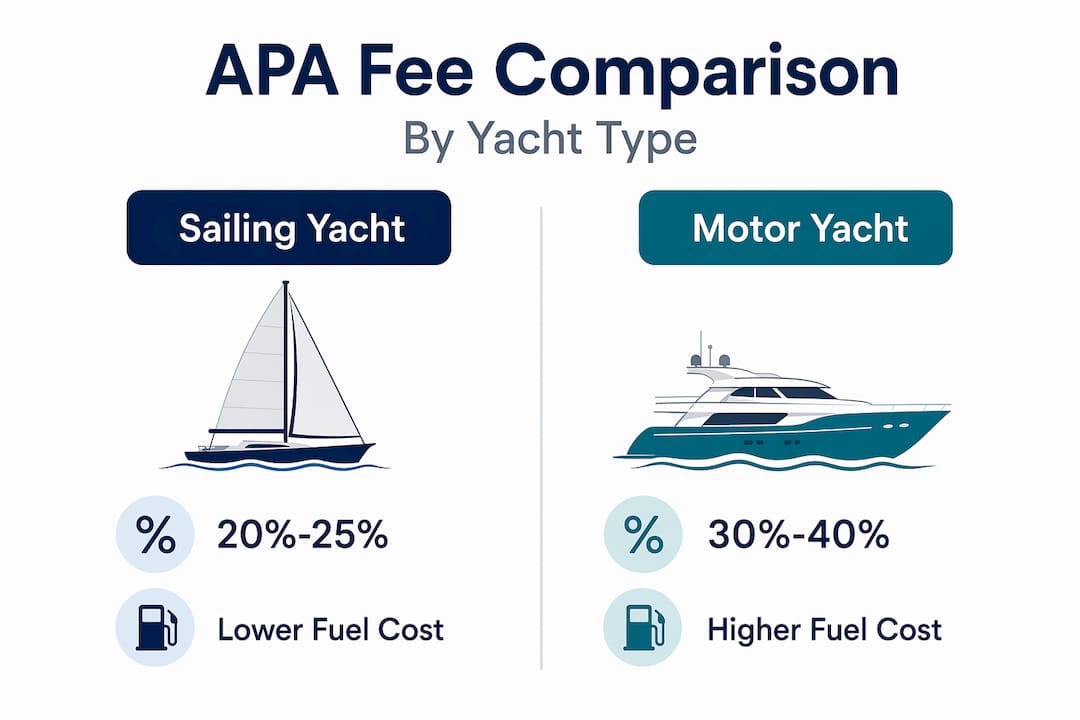
Sailboats typically carry an APA around 20% to 25% because their primary propulsion is wind. Motor yachts burn significantly more fuel and sit at the 30% to 40% end of the range. On a superyacht traveling at speed between destinations, fuel alone can consume the majority of the APA deposit.
Technology is shifting these norms. Hybrid-electric yachts like SEAWOLF X operate with APAs as low as 20% specifically because of their fuel efficiency. As more high-tech builds enter the charter market, the traditional 30% to 40% motor yacht APA is likely to compress over the next several years.
Destination is the other wildcard. Port fees in exclusive Mediterranean marinas during summer peak season are nothing like port fees at a quieter anchorage in autumn. At the extreme end, Monaco Grand Prix docking fees for large yachts can reach $165,000 plus VAT for the event week alone. That is the kind of destination-driven cost that can exhaust an APA deposit designed for normal conditions. Local knowledge, and advanced planning with your broker, is the only reliable protection against that kind of surprise.
For context on how destination affects total planning, understanding Sardinia charter port fees specifically can help you right-size your APA before departure rather than scrambling to adjust once you are underway.
Managing the APA during your charter
Depositing the APA and then forgetting about it until the final accounting is the wrong approach. Treating it as an active, managed fund throughout the charter leads to better outcomes and fewer end-of-trip surprises.
Here is how the process should work in practice:
Pre-departure provisioning planning: Work with the captain or chef before the charter begins to outline your preferences. Pre-ordering provisions reduces last-minute retail costs significantly.
Daily or every-other-day receipt collection: Best practice in APA management includes itemized receipts for every expenditure, so there is never ambiguity about where your money went.
Running balance updates: Proactive captains share a running total voluntarily. If yours does not, ask. Knowing your remaining balance helps you make real-time decisions about the itinerary.
Top-up process: If the APA runs short, your captain will inform you and request an additional deposit. This is standard and not a red flag, but it should come with an explanation of what drove the higher spend.
Final reconciliation: At charter end, you receive a full itemized statement. Review it line by line. Reputable crews welcome questions.
Pro Tip: Before your charter begins, give the captain a written list of your top priorities, whether that is specific food preferences, wine selections, or destinations you want to reach. This helps them allocate your APA in a way that reflects what actually matters to you, rather than defaulting to standard provisioning.
The captain’s role here is that of a fiduciary. The APA is client-owned money managed by the captain with full accountability. A professional crew treats it exactly that way. If your captain is vague about receipts or reluctant to share a running balance, that is a warning sign worth addressing directly before the charter progresses further.
My take: what most charterers get wrong about the APA
I’ve worked with enough first-time and returning charterers to recognize a pattern. Most of the frustration I see around APA comes not from the system itself but from treating it as an unknown quantity to be worried about rather than a tool to be used.
Here is what I’ve learned: charterers who engage with their APA proactively, who communicate preferences before departure and check in on balances mid-charter, consistently report better experiences. Not just financially. The quality of provisioning improves. The itinerary gets calibrated to what they actually want. The crew feels respected and responds with better service.
What I find particularly interesting right now is the technology shift. Fuel-efficient luxury charter yachts are quietly changing the economics of chartering. An APA at 20% rather than 35% on a week-long charter represents real money back in your pocket or redirected toward experiences you actually want. Paying attention to the yacht’s fuel profile when you are selecting a vessel is no longer a niche concern. It’s practical.
The broader point I’d make is this: the APA is not a hidden cost designed to obscure the real price of a charter. It is the most transparent cost structure in luxury travel. Your money, itemized, with a refund for what you do not spend. Most luxury spending does not work that way. Understanding it that way transforms how satisfying the whole experience feels.
— Emanuele
Plan your charter with Etcharters
Understanding the APA is one thing. Having an experienced team handle the planning is another. Etcharters specializes in luxury yacht charters in Sardinia and across the Mediterranean, with a particular focus on Porto Cervo, one of the most sought-after summer destinations in Europe. Every charter includes full cost transparency, detailed pre-departure APA guidance, and 24/7 support throughout your vacation so you are never left guessing about where your money is going. Whether you are chartering for the first time or refining how you approach costs on your fifth trip, the Etcharters team builds the full cost picture with you from day one. Explore the Mediterranean charter planning guide to see how smart planning makes every aspect of the experience better.
FAQ
What does APA stand for in yacht charters?
APA stands for Advance Provisioning Allowance. It is a prepaid fund deposited by the charterer before departure to cover variable onboard expenses like fuel, food, and port fees during the charter.
Is the APA refundable if I don’t spend it all?
Yes. Unused APA funds are fully refunded to the charterer at the end of the charter, accompanied by an itemized statement of all expenses.
How much should I budget for APA on top of my charter fee?
APA typically adds 25% to 35% on top of the base charter rate, with motor yachts at the higher end. Including gratuity and taxes, budget 45% to 55% above the base rate for your total cost.
Is crew gratuity included in the APA?
No. Crew gratuity is a separate payment at the end of the charter, typically 10% to 20% of the base charter fee, and is entirely at your discretion.
Can the APA run out during a charter?
Yes, particularly on itineraries with heavy fuel use or premium port stops. If the APA is depleted, the captain will request a top-up. Monitoring the running balance every few days helps you anticipate this before it happens.

